> For the complete documentation index, see [llms.txt](https://docs.prophaze.com/llms.txt). Markdown versions of documentation pages are available by appending `.md` to page URLs; this page is available as [Markdown](https://docs.prophaze.com/user-manual/ddos-attacks.md).
# DDOS Attacks
Detailed DDOS Attack Log Analyzing with various filter options.
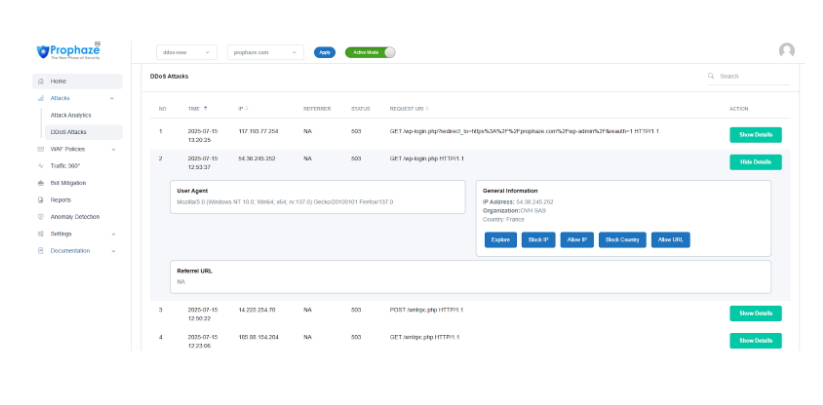
Similar to Attack Analyzer, DDOS Attack Analyzer provides immediate insight into recent DDOS attacks, featuring diverse filters for targeted analysis based on specific parameters, streamlining investigative efforts, and fostering deeper understanding.
By clicking "View" users can access the User Agent, request country, and Reference URL.
Additionally, users can blacklist or whitelist IPs, block countries, or whitelist requested URLs, providing versatile control over access management.
Displayed logs are tailored to individual IP addresses, consolidating all attacks from one IP into a singular log entry.
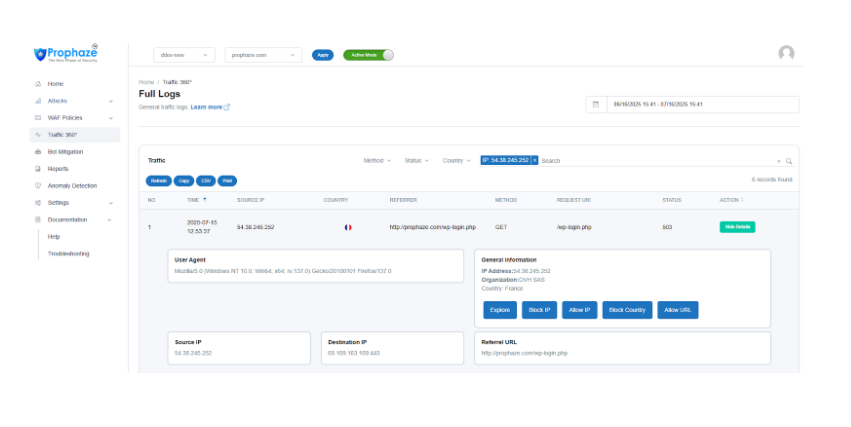
Clicking "Explore" launches a new tab, presenting an overview of all attacks associated with the designated IP.
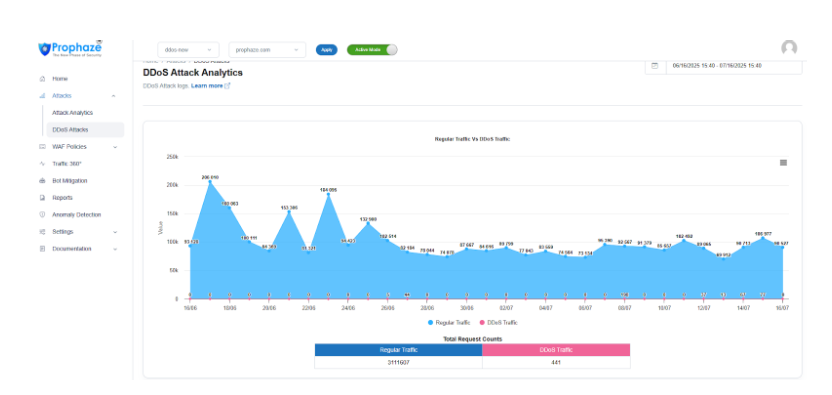
Another important feature is Traffic graph as shown below.
Comparative Traffic Graph: The DDoS attacks page features a visual graph. This graph compares regular website traffic with DDoS traffic over time. This visualization allows you to easily identify potential DDoS attacks by spotting spikes in DDoS traffic that deviate from your normal traffic patterns.
Traffic Request Counts: In addition to the graph, Prophaze provides a comparison of the total count for both regular traffic requests and DDoS traffic requests. This numerical data complements the visual representation in the graph and offers a more precise understanding of the attack volume.